This is the next post in a series about trading the Wheel Strategy. To start at the beginning, go to The Wheel Strategy – Introduction.
[Disclaimer: I’m not now, nor have I ever been, a financial advisor. Don’t do what I do just because I do it, I am not responsible for your decisions. Learn and do for yourself, take responsibility for your own decisions.]
For this example, I’m going to use a fairly well-known company, the Home Depot (Ticker Symbol: HD).
However, I am not going to use today’s prices. I want you to understand the concepts and I don’t want you getting hung up on the math.

So I am going to use made-up, easy-to-calculate-with, numbers.
So, when you go to look this up in real life, the numbers will be very different, but the formulas and concepts are not going to change. Those remain the same and you just run through the math with the actual numbers.
I’m also not going to include commissions and fees, just know that when I say you get $12.00 that you actually get $10.xx dollars because of commissions and fees.
Your commissions and fees will vary a bit depending on who you use.
Let’s get down to business.
For our example, we’re going to say that shares of Home Depot are trading for $100 each. We’re going to assume that both call options and put options are $0.10 per contract (remember, one contract controls 100 shares so it’s actually $10 even though the brokerages report it as ten cents) and that you have $9,000 to trade.
Now don’t worry about the $9,000 if you don’t actually have that much. I started trading with much, much, very much, less.
So you say to yourself, “I really want to buy shares of Home Depot but I don’t want to buy it at $100 a share, but I wouldn’t mind paying $90 a share.”
So you sell a put at the $90 strike price for $0.10 and collect $10 in premium (the money you get from selling an option is called a premium). Brokerages thought it would be easier for you to remember to multiply $0.10 by 100 rather than just listing it as $10.
ANYway… you have sold a put and collected $10 so now you have $9,010 in your account.
No matter what, that $10 premium you collected is yours to keep.
Then what?
When the put option hits its’ expiration date, you will either be assigned shares or you won’t. Either way, the put simply expires.
If the Home Depot stock is at $90 or more, your put will expire. If the stock is at $89 or below, you are assigned shares (this happens automatically, you don’t have to “do” anything). There is a cutoff as to whether you are assigned shares or not and I honestly don’t know where the cutoff is.
In other words, if Home Depot is at $89.99 you may not be assigned shares but at $89.90 you might be. Where the actual magic line is that the price must cross before you are assigned shares, I do not know. But the brokerage will tell you by the next day if you are assigned shares.
So if the put expires, then you simply sell another one. At the prices we’re using in our example, you now have $9,020 in your account. The $9,000 you started with and the $20 from the option premiums (selling the put, twice).
Let’s say that this time, rather than your put option expiring, someone exercises it and you are assigned shares.
That means that instead of $9,020 in your account, you now have $20 in your account and 100 shares of Home Depot that you bought at $90 a share (you paid it with your $9,000). That’s why it’s called a Cash Secured Put, because you already had the money to pay for the shares.
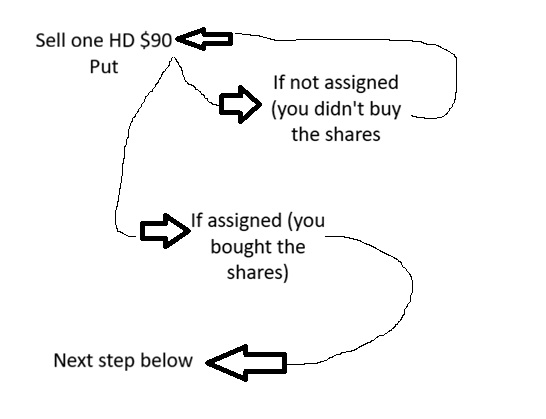
Now what do you do?
You can either just keep the stock and be happy you got it at your price, or you can sell the shares whenever the price hits something you like. For the Wheel Strategy, we sell a call and make some extra money whilst we wait.
A call is the opposite of a put. It’s called a Covered Call because we already own the shares of the stock.
So we think to ourselves, “I’m happy I got the stock at my price, and I made an extra $20 in the process, but if I sold the shares at $100, I would make $10 a share in profit for a total of $10,000.” (You would get back your $9,000 plus the $10 per share for $1,000 in profit).
To recap thus far: you made $20 selling puts, bought your stock at $90, and now you’re going to sell a covered call to sell your stock at $100.
So you sell a call, (sometimes people say “write a covered call” or “sell a covered call”) at the $100 strike price for $0.10 and collect $10.
Now you have 100 shares of Home Depot and $30 in your account.
When the option hits the expiration date, you either have your shares of stock called away (sold) or the option expires.
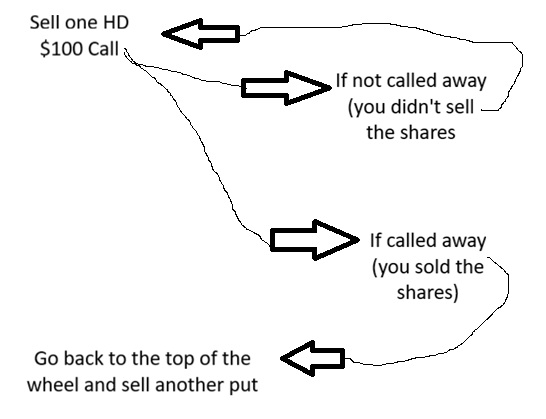
If the stock is below $100, the option expires. If the stock is $100 or up, the stock gets called away.
For our example, we’ll say Home Depot hit $100 and your shares were called away.
That means you now have zero (0) shares of stock and $10,030 in your account.
So then you’d start over and sell another put.
To recap:
You started with $9,000, sold a $90 strike price Cash Secured Put for $10, sold a second one for $10, were assigned shares, sold a Covered Call for $10, and had the shares called away at $100.
$9,000 + $10 + $10 – $9,000 + $10 + $10,000 = $10,030.
You just keep repeating the process: sell a put, buy the shares, sell a call, sell the shares.
Sometimes you can spend a long, long time selling puts before you get your shares of stock, which grows your account, slowly, but it does grow.
Sometimes you can spend a long, long time selling calls before you sell your shares of stock, but that also grows your account.
But I have questions….
What stocks should you pick? What stocks should you avoid? What strike prices should you use? Should you sell weekly or monthly options?
I think we’ve done enough for now. I’ll start tackling some of those questions in the next post.